

Key Takeaways
- Yes, you can recover what a former employee owes: unreturned equipment, relocation or signing bonus repayments, training costs, loans, and payroll overpayments.
- You need paperwork behind it. A signed agreement or an acknowledged policy turns a grievance into a debt.
- Don’t hold the final paycheck hostage. Federal law limits what you can deduct, and most states require written consent or ban the deduction outright.
- Training and relocation repayment clauses are under new legal pressure. California banned most new ones on January 1, 2026, and New York’s Trapped at Work Act kicks in December 19, 2026.
- Keep it calm: a written request, an easy way to return the property, a payment plan, then a collection partner when they go quiet.
- Summit A*R has recovered employee reimbursement debt for 30 years, with credit bureau reporting included at no extra cost.
The laptop never came back. The relocation bonus came with a two-year commitment, and they left in month seven. Payroll ran one cycle too long. Whatever the flavor, the feeling is the same: someone who used to be a part of the team owes your company money, and they’ve stopped answering your emails.
Employee reimbursement collections is the recovery of money a current or former employee owes an employer, and it’s one of the most awkward debts a business ever has to chase. Most companies handle it badly for exactly that reason.
Here’s the good news: this is a solvable problem, and it doesn’t have to get ugly. Most former employees who owe money aren’t villains. Maybe they’re dodging an awkward conversation, and if you handle it right, they’ll come around. Here’s what you can legally recover, what you can’t touch, and how to get the money back without turning a resignation into a lawsuit.
The Five Ways Former Employees Leave You Holding the Bag
Almost every employee debt falls into one of five buckets, and each one plays by slightly different rules.
- Unreturned equipment: Laptops, phones, tools, uniforms, vehicles. This is the most common one by a mile, and the return request is often ignored the moment the person has a new job.
- Relocation and signing bonuses: These usually come with a repayment clause if the employee leaves before a set period. The amounts are big, and the employee almost always knows the clause exists.
- Training and tuition costs: Certifications, degrees, and specialized training the company paid for on the condition that the employee stayed. Our guide on unpaid employee expenses covers the expense side.
- Loans and advances: Salary advances, hardship loans, travel advances that never got reconciled, and commission advances that were reversed when the deal fell through. We cover that last one in our article on bonus clawbacks.
- Wage overpayments: Payroll that keeps running after a termination date, a rate that’s keyed in wrong, a bonus paid twice. These have the most employer-friendly rules of the five. More on that below.
Paperwork First: What Your Agreements Need to Say
The strength of employee reimbursement recovery is decided on the day you hire, not the day they leave. Without a signed document that says the employee owes the money, and under what conditions, you leave yourself open to having to fight for money or equipment you may no longer be legally entitled to.
Start with the equipment, because it’s the most common gap. When a laptop or a phone or a set of tools goes out, put it in writing that it’s company property and must be returned, and have the employee sign an acknowledgment right then. The same principle applies to every bucket above. A relocation agreement should state the repayment amount, the period it covers, and how it prorates. A training agreement should tie repayment to the actual cost of the training. A loan should have a schedule and a signature.
Two features make these agreements far easier to enforce. Proration, where the amount owed shrinks each month the employee stays, reads as fair to a judge and to the employee. And a separate signed document, rather than a line buried on page 38 of the handbook, ends the “I never agreed to that” defense. Our article on building an effective employee reimbursement policy walks you through the policy side.
Can You Just Take It Out of the Final Paycheck? (Usually Not)
The instinct to hold the last check until a laptop is returned is understandable. In most states, it’s also illegal.
Federal law sets the floor. The Department of Labor’s Fact Sheet 16 says no deduction for tools, damage to company property, or theft can drop an employee’s pay below minimum wage or cut into overtime, and that holds “even if an economic loss suffered by the employer is due to the employee’s negligence.” Under federal law, a deduction for an unreturned laptop is allowed only from the pay above that line.
Then you have to worry about state laws. Most states either don’t allow deductions from any paycheck without the employee’s prior written consent, or don’t allow them at all. Massachusetts, New Jersey, New York, Oregon, and Pennsylvania are examples of the latter. California allows deductions only where the employee acted dishonestly, deliberately, or with gross negligence. Check your state rules to verify whether your internal paperwork complies.
| Situation | Federal rule | Check your state for |
| Unreturned laptop, phone, or tools | Deduction allowed only if pay stays at or above minimum wage and overtime. | Written-consent requirements, and several states that ban it entirely. |
| Damage or cash shortage | Same minimum wage floor, even if the employee was negligent. | States that forbid charging employees for damage or mistakes at all. |
| Relocation, signing bonus, training repayment | This is a contract debt, not a payroll deduction question. | Stay-or-pay laws that may limit or void the agreement itself (next section). |
| Payroll overpayment | Recoupment allowed without consent, even below minimum wage. | Limits like New York’s, which only allows it for clerical errors. |
The safe rule: pay the final check in full and on time, then go after the debt separately. A short or late final paycheck can trigger penalties that dwarf the value of the laptop you were trying to get back.
The One Exception: Payroll Overpayments
Payroll errors are the one place federal law leans your way. Under the Fair Labor Standards Act, employers generally don’t need permission to recoup an overpayment from a later paycheck, even if the deduction cuts into minimum wage. However, this only covers the actual overpayment, not added interest, administrative fees, or penalties. Also, deductions can’t cause you to underpay minimum wage or overtime for the hours worked in the pay period being corrected.
State rules still apply, and New York, for one, only allows deductions for mathematical or clerical errors. Some states require advance notice, written authorization, limits on the amount or timing of deductions, or prohibit deductions below the state minimum wage. The Fair Labor Standards Act doesn’t override those stricter rules.
Once an employee has left, though, there’s no paycheck to deduct from. The overpayment becomes an ordinary debt: request it, document it, and place it for collection if you have to. Our guide to reclaiming overpaid wages has the steps.
The 2026 Rule Changes on Training and Relocation Repayment
Stay-or-pay clauses, the ones that make an employee repay training or relocation costs if they leave early, were standard in offer letters for years. Several states have now restricted or banned them, and if you have staff in those states, you need to know which agreements still hold.
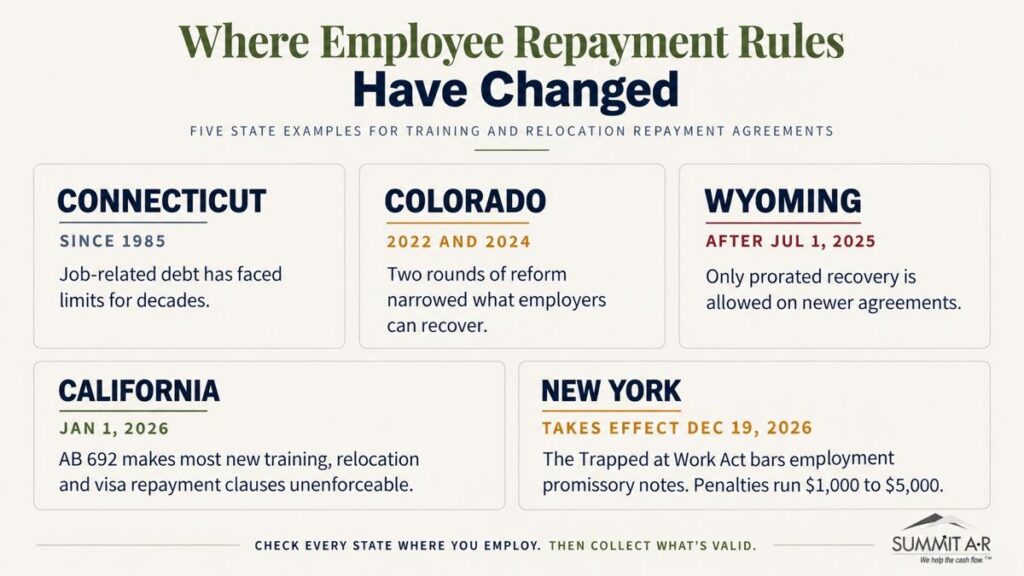
California was first. Assembly Bill 692 took effect on January 1, 2026. It makes unenforceable any new employment contract requiring a worker to repay training and education costs, relocation expenses, visa costs, or most sign-on bonuses on separation. A sign-on bonus clause survives only if it’s in a separate agreement, the worker gets five business days to review it, the repayment prorates, no interest is charged, and the retention period is two years or less. A worker who wins a claim can receive the greater of actual damages or $5,000, plus attorney’s fees.
New York followed with the Trapped at Work Act. A chapter amendment signed February 13, 2026, pushed the effective date to December 19, 2026. From that date, an employer can’t require an employee or applicant to sign an “employment promissory note,” meaning any agreement that makes the employee pay the employer if the job ends before a stated period. Penalties run $1,000 to $5,000 per violation. Colorado tightened its rules in 2022 and 2024, Wyoming now allows only prorated recovery for agreements signed after July 1, 2025, and Connecticut has banned job-related debt since 1985.
Everywhere else, a reasonable, prorated, clearly disclosed agreement that reflects the real cost of the training or the move is still generally enforceable. The practical advice: review every template before your next hire, prorate everything, and have an employment lawyer check the language for each state where you employ people.
Friendly but Firm: How to Recover It, Step by Step
Once the person is gone, recovery follows a sequence. Skipping steps is often what turns a collectible debt into a write-off.
- Settle up on the last day. Collect equipment at the exit meeting, get a signed return receipt, and hand over a written statement of anything still outstanding with the agreement attached. Your odds are never better than they are that afternoon.
- Send a written request within a week. State the amount, the document that supports it, a deadline, and how to pay or return the item. Keep it factual. Make the return as easy as possible: a prepaid, prelabeled box, even a small gift card for prompt return. A shipping label is trivial next to a $2,000 laptop.
- Offer a payment plan on larger balances. Someone who owes $8,000 in relocation costs and just started a new job usually can’t write one check. An installment plan with a signed agreement recovers more than a demand for the full amount.
- Document every contact. Dates, method, what was said, what was promised. If this ever reaches a collection agency or a courtroom, that log helps your case.
- Escalate when they go quiet. Two ignored written requests is the usual signal. At that point, your options are a collection agency, small claims court, or a lawsuit. For most balances, the agency is the cheapest and least disruptive of the three.
- Save legal action for big, well-documented debts. Litigation costs money whether you win or not. Summit A*R’s full-service litigation handles that step when it’s warranted, with costs approved in writing first.
| When | What to do | Why |
| Last day | Collect property, sign the return receipt, hand over a written statement of any balance. | Recovery odds are highest before they’ve moved on. |
| Within a week | Send the written request with the agreement and a clear deadline. | Establishes the debt and starts the paper trail. |
| Two to four weeks | Follow up once. Offer a payment plan if the balance is large. | Most cooperative former employees settle here. |
| After two ignored requests | Place the account with a collection agency. | An agency has tools, time, and legal cover your HR team doesn’t. |
| Large balance, strong paperwork | Consider litigation; costs approved up front. | Reserved for debts big enough to justify court. |
When It’s Time to Call In Help
An employer’s leverage over a former employee is limited. The usual tools, from a final-paycheck deduction to informal pressure, are either restricted by law or bad for your reputation. A collection agency that specializes in employee debt has options an internal team doesn’t.
Summit A*R’s employee reimbursement collections program starts by contacting the former employee by phone and mail, using the agreement you supply to explain the obligation and the benefits of resolving it.
If they’ve moved and left no forwarding address, our skip tracing department, run by a licensed private investigator, finds them. Reporting to all three major credit bureaus is included at no extra cost, which gives a former employee motivation to deal with a debt they’ve been ignoring. Every payment goes into a state-regulated trust account and comes to you on a fixed schedule, and you can follow each account in the client portal.
Remember, the person on the other end of that call used to be your colleague. They may be embarrassed, stretched thin at a new job, or convinced the clawback is unfair. We treat them accordingly. Our P.H.D. Philosophy (Preserve Human Dignity) means no threats, no late-night calls, and no tactics that would embarrass your company if the former employee described them to a colleague or posted them online. It works because it lowers the temperature. A former employee who’s treated with courtesy is far more likely to set up a payment plan than one who’s been cornered.
Your Current Team Is Watching
Every employee still on the payroll is watching how you handle the one who left. Recover what you’re owed quietly and fairly, and the message is that agreements mean something. Withhold a paycheck, badger someone at their new job, or vent about it online, and the message is that the company turns on people the moment they leave.
The goal is proportion. Recover the money you’re legitimately owed, follow the agreement, and let a professional handle the stubborn cases. That protects your cash, your legal position, and the culture you’ve built, all at once.

Let Us Take It From Here
If a former employee has stopped answering, Summit A*R can pick up the account today. We’ve recovered overpaid salary, tuition and training costs, relocation expenses, unreturned equipment, and unauthorized expenses for employers of every size since 1996, and we do it in a way you’d be comfortable having your current team see. Contact Summit A*R for a free consultation, tell us what’s owed and what agreement backs it, and we’ll give you a straight answer on what’s recoverable.
Did you find this article helpful? Just imagine how helpful our experts could be when it comes to your bottom line! Learn more about our full suite of services, or reach out to us today to discuss how we can help recover your lost revenue.
Frequently Asked Questions About Collecting From a Former Employee
Can an employer send a former employee to collections?
Yes. Once the employment relationship ends, money the former employee owes under a signed agreement, whether for unreturned equipment, a relocation repayment, a loan, or a wage overpayment, is an ordinary debt that can be placed with a collection agency. You’ll need documentation showing the amount and the agreement it comes from, and the agency has to follow federal and state collection rules when it contacts the individual. Summit A*R has handled these accounts for employers for three decades.
Can we hold the final paycheck until the laptop comes back?
No, and this is the mistake that costs employers the most. Final pay has to go out in full and on your state’s schedule, whether or not the property has come back. Federal law allows a deduction for unreturned equipment only if pay stays at or above minimum wage, and most states require prior written consent or ban the deduction altogether. Withholding the check can trigger wage penalties that cost far more than the equipment. Pay the check, then pursue the laptop as a separate debt.
Are relocation repayment agreements still enforceable in 2026?
In most states, yes, as long as the agreement is signed, clearly disclosed, prorated over a reasonable period, and tied to the actual relocation cost. California’s Assembly Bill 692 made most new relocation and training repayment clauses unenforceable as of January 1, 2026, and New York’s Trapped at Work Act bars employment promissory notes from December 19, 2026. Colorado and Wyoming restrict them too. Review your templates against every state where you employ people before relying on them.
Can we recover training costs from an employee who quit?
Often, if there’s a signed training repayment agreement that reflects the real cost of the training and prorates the amount over the retention period. Courts and regulators look hard at unprorated or inflated repayment demands, and California now bans most of these clauses in new contracts while other states tighten their rules. Where the agreement is valid, recovery works like any other employee debt: a written request, a payment plan offer, and a collection partner if the former employee stops responding.
How do we recover a wage overpayment from someone who no longer works here?
Start with a written notice that explains the error, states the amount, and offers a repayment plan. Most former employees cooperate once they understand what happened. Federal law would have let you deduct it from a paycheck while they were still employed (with conditions), but after separation the overpayment is simply a debt. If they ignore two requests, a collection agency experienced in employee reimbursement debt can pursue it, with credit reporting as leverage and without the cost of a lawsuit.