
 Received a Letter or Phone Call?
 Email Us

Key Takeaways
- Unpaid balances create a difficult kind of pressure for veterinary clinics. You want to provide compassionate care, support families through stressful decisions, and keep your practice financially healthy. But when invoices go unpaid, payroll, supplies, equipment, medications, and daily operations all feel the strain.
- Veterinary clinics can improve cash flow by setting clear payment expectations before care is provided, especially for urgent treatment, surgery, diagnostics, and ongoing care.
- Transparent billing reduces confusion, prevents avoidable disputes, and helps clients understand what they owe, when payment is due, and what options are available.
- Respectful follow-up keeps overdue balances from aging while preserving the trust clients have in your veterinary team.
- Efficient billing systems, aging reports, payment links, and written escalation policies help clinics recover revenue with less administrative strain.
- Professional debt collection support can help veterinary clinics resolve unpaid accounts while protecting client relationships, online reputation, and staff morale.
The challenge is that veterinary debt is personal. Behind every overdue account is a client who may feel embarrassed, overwhelmed, or frustrated. With the right systems, your clinic can protect cash flow while preserving trust. Better financial conversations, clearer processes, and respectful recovery strategies can help you get paid without making clients feel punished.
Clear, Transparent Communication
Cash flow problems often begin before an invoice becomes overdue. When clients are unsure what services cost, when payment is expected, or what happens if they can’t pay in full, confusion can turn into avoidance. Clear communication helps prevent that breakdown.
Your clinic should explain estimates, deposits, payment deadlines, and accepted payment methods in writing, before treatment whenever possible. This is especially important for urgent care, surgery, diagnostics, dental procedures, and chronic condition management, where costs can accumulate quickly.
Transparency Also Protects Your Team
Staff members shouldn’t have to improvise answers when clients ask about payment expectations or overdue balances. A written financial policy gives everyone the same language and reduces awkward, inconsistent conversations.
Forthright financial discussions are far from cold. In fact, clarity often makes them feel kinder. When clients know what to expect, they can make informed decisions, ask questions earlier, and avoid the shame or frustration of a surprise bill.
Educate Clients on Your Financial Policies
Many veterinary clients do not fully understand how clinics manage payment. They may assume billing works like human healthcare, where insurance, co-pays, delayed statements, or large administrative systems are common. Veterinary medicine usually operates differently, and that gap in expectations can create tension.
Your financial policy should explain when payment is due, whether deposits are required, how estimates work, what financing options are available, and how overdue accounts are handled. This information should be easy to find on your website, intake forms, treatment estimates, and discharge paperwork.
Education is especially valuable when it’s framed around continuity of care. Clients may respond better when they understand that timely payments help your clinic maintain staffing, stock medications, invest in equipment, and continue offering high-quality care to the community.
The best policies are written in plain language. Avoid dense legal wording unless required. Clients should be able to quickly understand their responsibilities and the clinic’s options. When financial expectations are treated as part of the care experience, payment conversations become more normal, less emotional, and easier for both sides.
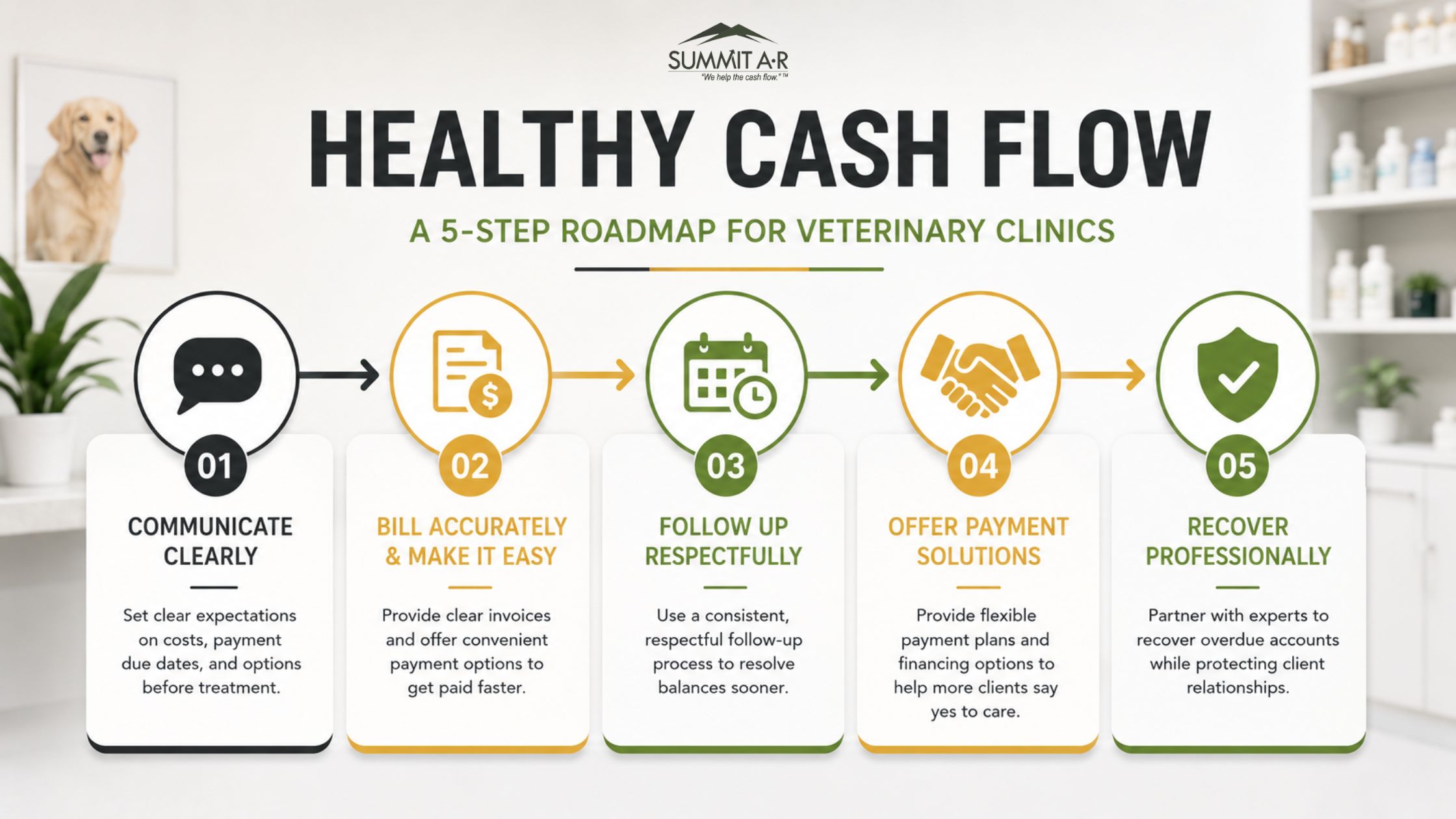
Consistent and Respectful Follow-Up
Overdue balances become harder to collect when follow-up is inconsistent. If your clinic waits too long to contact clients, the account can feel less urgent to them and more uncomfortable for your team. A simple, repeatable follow-up process helps prevent accounts from aging unnecessarily.
Scheduled Reminders
The first reminder should be polite and matter-of-fact. Many missed payments are not intentional. A client may have forgotten, missed an email, changed cards, or misunderstood the due date. Starting with a respectful reminder keeps the relationship intact and gives the client an easy path to resolve the balance.
Follow-up should become more structured as time passes. For example, your clinic might send a reminder shortly after the due date, follow up again after a set number of days, then make a phone call or send a more formal notice if the account remains unpaid. Every step should be documented in your practice management system.
Tone & Consistency Are Key
Clients are more likely to respond when they feel respected, not shamed. Use clear language such as, “Your account has a past-due balance of $___, and we would like to help you resolve it.” Avoid language that sounds accusatory or emotionally loaded.
Consistency reduces staff stress. When your team knows exactly what happens at each stage, they don’t have to decide how firm to be on a case-by-case basis. A respectful process allows your clinic to take overdue balances seriously without making financial follow-up feel confrontational.
Optimize Your Billing & Collection Processes
A clinic’s billing process has a direct effect on cash flow. Even small inefficiencies can create preventable delays, especially in busy practices where staff are already balancing appointments, phone calls, records, prescriptions, emergencies, and client questions.
Start by reviewing how invoices are created and delivered. Are estimates converted to invoices accurately? Are deposits recorded properly? Are clients receiving receipts and payment links right away? Are balances visible and easy to understand? Confusing invoices often lead to delayed payment because clients hesitate to pay charges they don’t fully understand.
Make Payments Convenient
Your clinic should make it as easy as possible for clients to pay through secure card processing, online payment links, text-to-pay and mobile app options, payment portals, or approved financing solutions. The fewer steps a client has to take, the more likely they are to resolve the balance promptly.
Stay On Top of the Books
Aging reports should be reviewed regularly. These reports show which accounts are current, which are becoming overdue, and which require escalation. Waiting until balances are 90 or 120 days past due gives clients more time to disengage and makes recovery more difficult.
Your clinic should also define internal thresholds. For example, staff should know when an account moves from a reminder stage to a management review, when payment plans are allowed, when services may be limited due to unpaid balances, and when third-party support should be considered.
Efficient billing is about speed, reducing friction, improving accuracy, and making sure every overdue account receives the right action at the right time. When the process is organized, your team can spend less time chasing balances and more time supporting patients and clients.
Outsourcing and Professional Debt Collection Support
There comes a point when internal follow-up stops being the best use of your team’s time. Veterinary staff are trained to care for animals, support clients, manage records, and keep the practice moving. Asking them to repeatedly pursue overdue balances can create stress, inconsistency, and uncomfortable client interactions.
Professional debt collection support for veterinary clinics can recover unpaid balances while protecting the client relationship. The key is choosing an agency that understands the sensitive nature of veterinary debt. A pet owner may be dealing with grief, financial strain, frustration over treatment outcomes, or guilt about not being able to pay immediately. Heavy-handed tactics can damage your clinic’s reputation and make a difficult situation worse.
How the Right Debt Collection Team Operates
A reputable collection partner should communicate professionally, follow all state and federal laws, document activity, and give clients clear options for resolving their accounts. The tone should be firm enough to create accountability, but respectful enough to preserve dignity.
The Summit A*R approach is especially relevant for veterinary clinics. Through our P.H.D. Philosophy, which stands for Preserve Human Dignity, we focus on recovering revenue without using threats, robo-calls, or aggressive tactics. That matters for practices that rely on trust, referrals, online reviews, and long-term client relationships.
A full-service agency should be able to apply specialized recovery processes, skip tracing when needed, structured communication designed to move accounts toward resolution, and litigation services if necessary.
For many clinics, the right time to involve a professional agency is after internal reminders have been sent, the account has reached a defined age, and the client hasn’t responded or followed through on a payment arrangement. Clear escalation criteria help your clinic stay consistent and avoid letting old balances drain revenue month after month.

Proactive Payment Planning
The strongest collection strategy begins before a balance becomes overdue. Proactive payment planning and professional pre-collection services give clients more ways to say yes to care while helping your clinic reduce its unpaid accounts.
Payment planning should be realistic. A payment plan that looks good on paper but does not match the client’s actual ability to pay is likely to fail. It is better to set clear terms, reasonable dates, and specific consequences if payments are missed.
Documentation is essential. Every plan should include the balance owed, payment amounts, due dates, accepted payment methods, and what happens if the agreement is not followed. This protects your clinic and the client.
Train Your Staff for Sensitive Financial Interactions
Financial conversations in veterinary care require skill. Clients may be anxious about their pet, upset about unexpected costs, or embarrassed about an overdue balance. Without training, even well-meaning staff can sound uncaring, uncertain, defensive, or too forceful.
Team members should know how to explain estimates, ask for payment, discuss overdue balances, and respond when clients say they cannot pay. They should also know when to involve a manager instead of trying to resolve a complex situation alone.
Scripts & Role-Playing
Role-playing can be useful because it prepares staff for real conversations. Common scenarios might include a client disputing a charge, asking for an exception, missing a payment plan installment, or becoming emotional at checkout. Practicing responses helps staff stay calm and consistent.
Scripts can also help, if they don’t sound robotic. The best scripts give staff a respectful framework while allowing room for natural conversation. For example, “I understand this is a lot to manage. Let’s review the balance and the options available today.”
Strong training protects the client relationship and your team’s morale. When staff feel prepared, financial conversations can become less stressful and more productive.
In Short,
Healthy cash flow gives veterinary clinics more room to do what clients value most: provide attentive, reliable care when their pets need it. But revenue recovery should never feel disconnected from compassion. The clinics that handle financial policies well understand that payment conversations are part of the client experience, not an interruption of it.
If overdue accounts are putting pressure on your practice, we can help you recover more of what you are owed while protecting the relationships your clinic has worked hard to build. Contact Summit A*R today to discuss expert debt collection support for your veterinary clinic. With recovery rates consistently double the national average, we’re proof that respectful, professional collections can turn more receivables into recovered revenue.
Frequently Asked Questions About Veterinary Clinic Debt Collection
How can veterinary clinics improve cash flow without upsetting clients?
Veterinary clinics can improve cash flow by communicating costs early, providing written estimates, offering convenient payment options, and following up on overdue balances with a respectful tone. Clients are more likely to respond positively when payment expectations are clear, consistent, and framed as part of a professional care experience rather than a punishment.
Why is transparent billing important for veterinary practices?
Transparent billing helps veterinary clients understand the cost of care before confusion turns into nonpayment. Clear invoices, written estimates, deposit policies, and payment deadlines reduce disputes and make financial conversations easier for staff. When clients know what to expect, they are more likely to pay on time or ask for help earlier.
When should a veterinary clinic send an account to collections?
A veterinary clinic should consider collections after internal reminders have been sent, the balance has reached a defined age, and the client has not responded or followed through on payment arrangements. Many clinics set escalation points at 60, 90, or 120 days, depending on their financial policy and account history.
Can debt collection damage a veterinary clinic’s reputation?
Debt collection can damage a veterinary clinic’s reputation if it is handled aggressively, inconsistently, or without regard for the client relationship. A professional agency that uses respectful communication, follows applicable regulations, and documents every step can help recover unpaid balances while protecting the clinic’s image and client trust.
How does professional debt collection help veterinary clinics?
Professional debt collection helps veterinary clinics recover overdue accounts without putting front-office staff in repeated uncomfortable conversations. A qualified agency can manage follow-up, locate hard-to-reach clients, negotiate payment, and escalate accounts appropriately. This allows the clinic team to focus on patient care while revenue recovery continues in a structured, professional way.


