

Key Takeaways
- Reputable commercial collection agencies work on contingency: no recovery, no fee.
- Summit A*R’s contingency fees run from 7.5% to 50%, with no minimums, no quotas, and nothing upfront.
- Your rate depends on how old the account is, how big the balance is, how many accounts you place, and how good your paperwork is.
- A low rate is a bad deal if the agency doesn’t collect. What you keep is the number that matters.
- The most expensive fee is the one you pay by waiting. Once an invoice passes 90 days, your chances of recovering it drop by more than half.
- Before you sign anywhere, ask about upfront fees, minimums, legal costs, and when your money actually gets sent to you.
Sooner or later, every business owner who’s tired of chasing an invoice asks the same question: what’s a collection agency going to cost me? It’s a fair question, and many agencies might answer it with a figurative shrug and a “well, it depends.” It does depend. But the factors are predictable, the model is simple, and you deserve a straight answer before you hand anyone your receivables.
So here’s ours, along with what actually determines where you land. And one thing worth saying up front: the customer who owes you usually isn’t a villain. They’re behind, they’re dodging an awkward conversation, and the right agency brings them back to the table without anyone losing face. That’s the whole trick to getting paid and keeping the customer.
No Recovery, No Fee: How Contingency Pricing Works
A contingency fee is the percentage of a recovered debt that the agency keeps as payment. If the agency recovers nothing, you owe nothing. That’s the model almost every reputable commercial collection agency uses, and it exists for a simple reason: collecting a debt is uncertain work, and nobody wants to pay for effort that produces nothing. The agency takes the risk. You pay on results.
It also puts you and the agency on the same side. They don’t get paid until you do, so there’s no incentive to sit on a file.
What Summit A*R Charges
We publish our pricing approach rather than making you pry it out of us. Our contingency fees range from 7.5% to 50%, depending on the age, type, and balance of the account. We’re paid only when we recover your money. No quotas, no minimums, no upfront fees. You decide which accounts to place and when.
Compare that to agencies that charge a placement fee, an annual membership, or require you to hand over a set number of accounts every month. Those arrangements can leave you paying whether or not a dollar comes back.
A few other things worth knowing before you place anything:
- Your money sits in a state-regulated client trust account. The net amount due to you for any month goes out on the 10th of the following month, so you can plan around it.
- Legal action never happens by surprise. If an account needs it, we tell you what it will cost and get your written approval before a dollar is spent.
- You can watch every account move. Our client portal shows status, payment activity, and custom reports, 24/7.
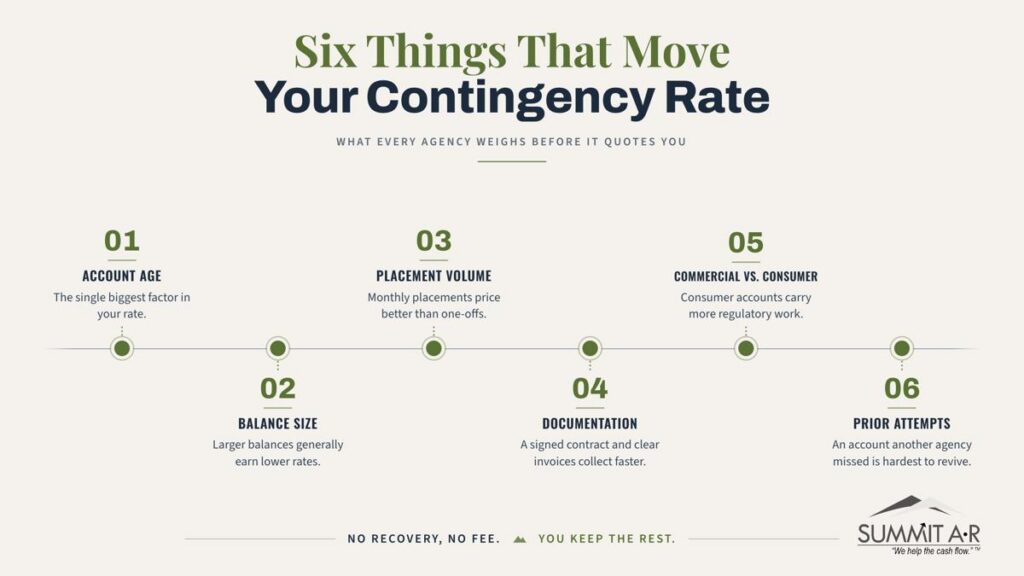
Six Things That Move Your Rate Up or Down
Every agency weighs the same handful of factors when it quotes you. Know them, and you can predict roughly where you’ll land before you pick up the phone.
- Age of the account: The single biggest factor. Every month a balance sits unworked, the odds of collecting drop and the effort required goes up.
- Size of the balance: Larger balances generally earn lower rates, because the agency’s effort is spread across more recoverable dollars.
- Volume: A business placing accounts every month gets a “volume discount,” and rates reflect that.
- Documentation: A signed contract, clear invoices, and a paper trail of reminders make an account far faster to collect than a handshake deal and a vague email thread.
- Commercial vs. consumer: Business debtors aren’t covered by the Fair Debt Collection Practices Act the way individual consumers are. Consumer accounts carry more regulatory work, and agencies price them differently.
- Prior collection attempts: An account another agency already failed on is the hardest kind to bring back.
The Other Fee Models You’ll Run Into
Contingency is the standard for commercial work, but you’ll see a few alternatives in proposals. Each one shifts some risk back onto you.
Flat fee per account. You pay a fixed amount per placement regardless of outcome, usually as part of a high-volume program built around a standard letter series. That can be a bargain when a reminder is genuinely all your customer needs. It’s a poor deal when the account needs investigation, skip tracing, and real follow-up, because you’ve already paid whether or not anything comes back.
Hourly billing. You’re paying for time rather than results. Rare in commercial collections, and it means a slow file costs you more, not less.
Attorney rates. Once a lawsuit is on the table, the economics change, because attorneys and court filings cost money whether or not you win. A good agency explains those costs before anything is filed and gets your approval in writing. That’s how Summit A*R handles full-service litigation, every time.
The Rate Isn’t the Whole Story: What You Actually Keep
Here’s where a lot of business owners get it backwards. They shop for the lowest percentage. But the rate is only half the math. The other half is how much the agency actually recovers, and a cheap percentage of very little leaves you worse off than a fair percentage of most of it.
So the question to ask isn’t “what’s your rate?” It’s “what do your clients actually keep?” Ask for documented recovery results by industry and account age, alongside the fee schedule.
Ours are a matter of record. Summit A*R’s recovery rates run nearly double the industry average; we’ve recovered more than $250 million for clients to date, and we resolved over 25,000 accounts in the past year alone. Every collector on staff carries at least ten years of experience, and our skip-tracing department is run by a licensed private investigator. Any agency worth hiring should be willing to put comparable numbers in front of you.
Want to see what your receivables are worth right now? Our accounts receivable calculators make it quick.
The Most Expensive Fee Is the One You Pay by Waiting
Plenty of businesses sit on an account for months to avoid paying a fee. That delay almost always costs more than the fee would have.
Once an invoice passes 90 days past due, your chances of recovering it drop by more than half, and they keep falling from there. Aged accounts also carry higher contingency rates, because they take more work to collect. So waiting hits you twice: the odds go down, and the rate goes up.
Then there’s the staff time nobody tracks. Every hour your bookkeeper spends on reminder calls is an hour not spent on work that earns revenue.
Our guide on when to send a past-due account to collections covers the timing in detail. Short version: once a customer has ignored a second notice, waiting longer just makes the account cheaper to write off and more expensive to recover.
Can You Pass the Fee On to the Customer?
Sometimes, but only if your contract says so. Under the Fair Debt Collection Practices Act, a collector can’t add interest, fees, or charges unless the agreement creating the debt expressly allows it. That rule governs consumer debt, and commercial contracts follow the same logic in practice: courts enforce a collection-costs clause that’s written into the agreement and reject fees tacked on after the fact.
So put a clear collection-costs and attorney-fees clause in your credit application before you extend terms, and have your own counsel check it against your state’s rules. With that language in place, an agency can pursue the balance plus the authorized costs. Without it, the fee comes out of your recovery. That’s the situation most businesses are in when they first call us, and it’s an easy one to fix for next time.
Seven Questions to Ask Before You Sign Anything
A transparent agency answers all of these without blinking. A vague answer to any of them tells you something.
- Is the rate contingency only? Some agencies charge a placement fee, an annual membership, or both. That means you can pay and still not recover anything.
- Are there minimums or quotas? Contracts that require a set number of accounts per month can leave you paying for placements you never intended to make.
- How does the rate change with the age and size of the account? Get the full schedule in writing.
- What does legal action cost, and who approves it? You should never learn about court costs after they’ve been incurred.
- Where’s my money held, and when do I get it? Recovered funds should sit in a regulated trust account and go out to you on a fixed schedule.
- What are your documented recovery rates in my industry? The fee only matters in relation to what comes back.
- How will you treat my customers? An agency that torches a relationship you wanted to keep has cost you future revenue, and that’s never reflected on their invoice. Our article on why professional collections protect business relationships explains what respectful recovery looks like.
The Part That Isn’t on the Rate Sheet
What clients tend to remember about their experience with us isn’t the percentage. It’s our P.H.D. Philosophy (Preserve Human Dignity). No robocalls, no threats, no pressure tactics. The people who owe your money get treated like people.
That isn’t softness. It’s how you get paid. A customer treated with respect picks up the phone, works out a plan, and often comes back to buy from you again. After 30 years and an A+ rating with the Better Business Bureau, we’ve found it recovers more and costs you less.

Ready to Find Out What Your Accounts Are Worth?
If you’ve got commercial accounts sitting past 60 days, the most useful next step is a short conversation about what they’re worth and what it would cost to recover them. Contact Summit A*R for a free consultation. You’ll get a rate, a realistic timeline, and an honest read on which accounts are worth placing. No pressure, no false promises.
Did you find this article helpful? Just imagine how helpful our experts could be when it comes to your bottom line! Learn more about our full suite of services, or reach out to us today to discuss how we can help recover your lost revenue.
Frequently Asked Questions About Collection Agency Fees
What percentage does a commercial collection agency take?
Reputable commercial agencies work on contingency, keeping a percentage of what they actually recover and nothing at all if they recover nothing. Where you land depends on how old the account is, how large the balance is, how many accounts you place, and how well documented the debt is. Summit A*R’s published range is 7.5% to 50%, and the exact rate is agreed in writing before a single account is placed, so there are no surprises later.
Do collection agencies charge upfront fees?
Reputable commercial agencies generally don’t, because the contingency model means they earn only from money they actually recover. Some agencies do charge placement fees, annual memberships, or monthly minimums, so ask the question directly before you sign anything. Summit A*R charges no upfront fees, no quotas, and no minimums. You pay nothing on an account unless we recover it, which keeps the risk on our side rather than yours.
Is it worth sending a small invoice to collections?
Often, yes, as long as your share after the fee still beats writing the balance off entirely. A contingency agency costs you nothing if it fails, so the downside is limited to the time it takes to place the account. The real question is timing. A small invoice placed while it’s still relatively fresh has a far better chance of coming back than the same invoice placed a year later, and it will usually earn a lower rate too.
Who pays the collection agency fee, the business or the debtor?
The business that hires the agency pays the fee out of the recovered amount, unless the original contract with the customer expressly allows collection costs to be added to the debt. Federal law bars collectors from adding fees the agreement doesn’t permit, and commercial contracts follow the same principle. Adding a clear collection-costs clause to your credit terms before you extend credit is the only reliable way to shift that expense to the customer who owes you.
When should a business send a commercial account to collections?
As soon as you genuinely doubt you’ll be paid. For most businesses that means after a customer has ignored a second late notice, usually somewhere around 60 to 90 days past due. Once an invoice passes 90 days, the chance of recovering it drops by more than half, so every month of delay lowers both the recovery and your leverage. Placing earlier also tends to earn you a lower contingency rate.