

Key Takeaways
- Ethical tuition collections help educational institutions recover unpaid balances without damaging student, family, alumni, or community relationships.
- Clear documentation, accurate account records, and consistent communication reduce disputes and make the recovery process more professional.
- Respectful outreach often improves response rates because students and families are more likely to engage when they feel heard.
- Payment plans and structured resolution options can help institutions recover more revenue while giving account holders a realistic path forward.
- Legal escalation should be used selectively, with proper documentation, compliance review, and qualified attorney support when appropriate.
- Tailored collection solutions work better than generic workflows because tuition debt varies by institution type, account age, balance size, and student circumstances.
- A reputation-conscious collection partner helps protect both cash flow and institutional trust.
Unpaid tuition and student fees create real pressure for schools. Revenue gaps affect staffing, programming, technology, facilities, and the student experience everyone is working so hard to protect. At the same time, collections can feel sensitive because every account is connected to a student, a family, and your institution’s public reputation.
Ethical education and tuition collections give schools, colleges, and universities a better path forward. With the right process, you can protect your cash flow and recover overdue balances while treating people fairly, communicating clearly, and preserving trust in your mission.
The Debt Collection Process & Communication
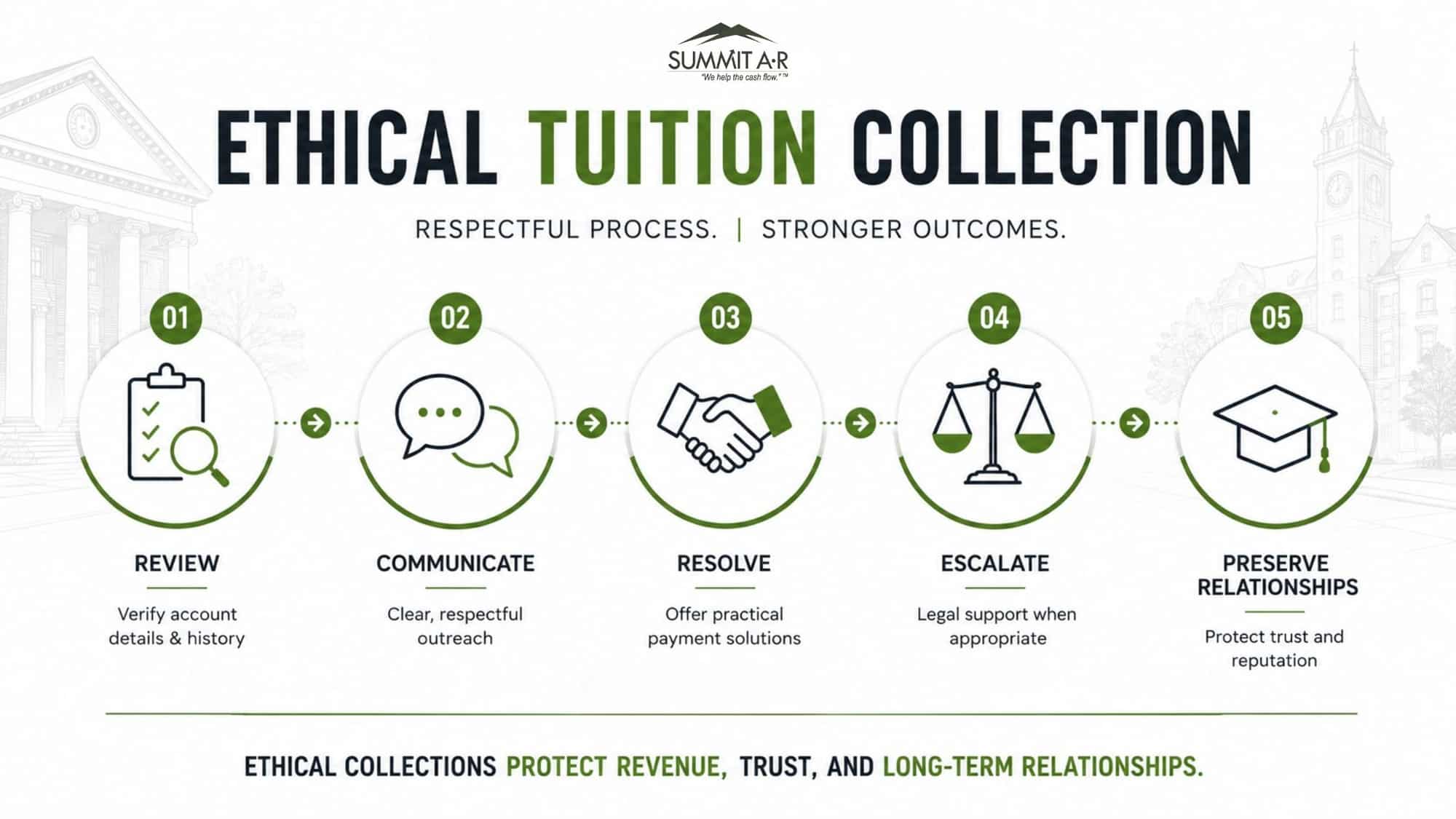
A strong tuition collection process begins before the first outreach attempt. Educational institutions need accurate account information, clear balance details, documentation of prior communications, and a complete understanding of the student’s account history. This helps prevent confusion, duplicate outreach, and unnecessary disputes. It also allows the collection team to approach each account with the right context instead of treating every past-due balance the same way.
The first step is typically account review. This includes confirming the amount owed, identifying the type of balance, checking whether the debt relates to tuition, housing, meal plans, fees, or other charges, and reviewing any prior payment arrangements. Also, if a student or responsible party has already raised a concern, that issue should be visible before new collection activity begins. Ethical collections depend on accuracy, as even a small error can damage trust and have a cascading social media impact.
Communicating with Tuition-Based Debtors
Communication should be professional, respectful, and easy to understand. Students and families should know who is contacting them, why they are being contacted, what balance is being discussed, and what options may be available. Overly aggressive language may create short-term pressure, but it often increases complaints, disputes, and reputational risk. Clear communication produces better outcomes because people are more likely to respond when they feel respected.
Timing also matters. Outreach should be consistent enough to keep accounts moving, but not so frequent that it feels harassing or disruptive. Phone calls, letters, emails, and digital communication should follow applicable laws, like the federal Fair Debt Collection Practices Act, and institutional communication preferences. Every interaction should be documented so your institution has a reliable record of what was said, when contact occurred, and what next steps were offered.
Payment discussions should focus on resolution. Some students may be able to pay in full, while others need structured repayment options. A thoughtful collection partner can help identify practical arrangements without making promises your institution can’t support. The goal goes beyond payment demands to creating a responsible path that moves the account toward resolution while maintaining the dignity of the person on the other side of the balance.
Ethical and Professional Debt Collection Practices
Educational institutions have a duty to protect their financial health, but they also have a responsibility to uphold the values their communities associate with education. That means collections should never rely on intimidation, misleading statements, shame, or pressure tactics that could harm a student’s future relationship with the institution.
Professionalism starts with tone. Every message should recognize that unpaid tuition can result from many circumstances, including family hardship, administrative confusion, job loss, health challenges, or a misunderstanding about financial aid. In many cases, a respectful tone improves debt recovery when students and families are not being treated like adversaries.
The Case for Transparency
People should understand the balance, the consequences of continued nonpayment, available payment options, and how to dispute an account if they believe something is wrong. Ethical collection practices leave less room for confusion and help prevent issues from escalating unnecessarily.
Staff training and oversight also play a major role. Collection representatives should be constantly updated on and understand compliance requirements, communication standards, privacy expectations, and the unique sensitivities of education-related debt. They should know how to de-escalate tense conversations, respond to hardship situations, and document disputes properly.
At Summit A*R, our P.H.D. Philosophy, Preserve Human Dignity, guides how accounts are handled, and our collection reps are regularly trained on new collection laws. This is especially crucial for educational institutions. A student who owes a balance today may become an alum, donor, employee, parent, or community advocate tomorrow. Ethical collections protect more than revenue. They also protect the long-term value of the relationship, your school’s reputation, and its legal exposure.
Legal Support in Debt Collection
Legal support can be an important part of tuition debt recovery, but it should be used carefully and only when appropriate. Most educational institutions don’t want every unpaid account pushed toward legal action, nor should they. A sound collection strategy uses legal escalation as one possible tool within a broader recovery process, not as the default response to every delinquent balance.
Before legal action is considered, the account should be thoroughly reviewed, and a cost-benefit analysis done. Also, the institution and its collection partner should confirm the balance, supporting documentation, applicable agreements, payment history, prior notices, and any dispute activity. This review helps determine whether the account is suitable for escalation and whether additional communication may still resolve the matter without legal involvement.
Compliance is Key in Education-Related Collections
Depending on the account and circumstances, institutions and collection agencies may need to consider federal and state debt collection rules, consumer protection laws, privacy requirements, credit reporting rules, and institutional policies. Student account information may also involve sensitive data, so privacy and data security must be handled with care at every stage.
When legal escalation is appropriate, the process should be handled through qualified legal professionals. A collection agency can help organize documentation, prepare the account for attorney review, and support the institution with reporting and communication. However, legal advice and litigation decisions should come from properly licensed counsel. This protects the institution and ensures that any next step is grounded in the facts of the account and the laws that apply. At Summit, we provide full-service litigation services that handle the entire process on your behalf.
Legal Support Doesn’t Always Mean Filing a Lawsuit
Legal support may involve demand letters from an attorney, settlement review, documentation assessment, or guidance on whether a claim is worth pursuing.
In some cases, the cost, age, amount, or circumstances of the debt may make litigation impractical. In others, legal action may be the right path for larger balances, repeated broken arrangements, or accounts where the debtor actually can pay but refuses to engage.
The key is disciplined escalation. Ethical legal support balances recovery potential with reputational risk, compliance requirements, and the institution’s values.
Tailored Collection Solutions
Educational institutions don’t all collect the same types of debt. A private K-12 school, trade school, community college, university, online education provider, and continuing education program may each face different account patterns, payment cycles, student demographics, and reputational concerns. Tailored collection solutions help ensure the recovery process fits the institution instead of forcing every account into a generic workflow.
Account Segmentation
Recent balances may benefit from early intervention and softer communication, while older accounts may require more persistent outreach. Smaller balances may be best handled through streamlined campaigns, while larger tuition debts may deserve deeper review and more personalized resolution efforts. Accounts involving disputes, withdrawn students, or financial aid complications may need special handling.
Communications Standards
Some schools want a warm, student-first tone. Others need a firmer process for long-overdue balances. Many want both, with communication becoming more direct as accounts age. The right partner should be able to reflect your institutional voice while still moving accounts toward payment.
Account Reporting
Educational institutions need visibility into placements, recoveries, payment plans, disputes, contact activity, and account status. Strong reporting helps finance teams understand performance, identify trends, and improve internal billing procedures before accounts become harder to recover. Alongside regular reporting to our clients, Summit’s client portal allows educational institutions and other clients to view real-time account statuses, pull reports, and add new accounts, among other features.
The most effective tuition collection solutions feel structured, humane, and accountable. They give your team a clear process, your students a fair opportunity to resolve their balances, and your institution a better chance of recovering revenue without creating unnecessary reputational strain.
In Short
Debt recovery should never make an educational institution feel like it has to choose between financial responsibility and community trust. The right collection partner helps you protect both by bringing discipline, empathy, and compliance into the same process. If your institution needs a more professional and successful way to recover unpaid tuition and fees, Summit A*R is here to help turn receivables into revenue. Reach out to us for a free consultation today!
Frequently Asked Questions About Ethical Education & Tuition Collections
What are ethical tuition collections?
Ethical tuition collections are debt recovery practices that help schools, colleges, and universities recover unpaid tuition and fees while treating students and families fairly. This includes accurate account review, respectful communication, clear payment options, proper documentation, privacy protection, and compliance with applicable debt collection laws.
How can educational institutions collect unpaid tuition without harming their reputation?
Educational institutions can protect their reputation by using professional, respectful communication, avoiding aggressive tactics, offering reasonable payment options, and partnering with a collection agency that understands student account sensitivity. The goal is to recover balances while preserving trust with students, families, alumni, and the broader community.
When should a school or university send unpaid tuition to collections?
A school or university should consider collections when internal billing efforts have not resolved the balance, the account is clearly documented, and the student or responsible party has received appropriate notices. Early placement can improve recovery, but the process should still reflect the institution’s communication standards and compliance requirements.
Can tuition debt be handled with payment plans?
Yes, many tuition debts can be resolved through payment plans when the student or responsible party cannot pay the full balance at once. Structured repayment options can improve recovery, reduce disputes, and give families a practical way to resolve overdue tuition while keeping the account active and documented.
What laws apply to tuition debt collection?
Tuition debt collection may involve federal and state debt collection laws, consumer protection rules, privacy requirements, credit reporting regulations, and institutional policies. Because requirements vary by account type and location, educational institutions should work with a compliant collection partner and qualified legal counsel when escalation is being considered.
Does legal support always mean filing a lawsuit for unpaid tuition?
No. Legal support may include attorney review, demand letters, documentation assessment, settlement guidance, or litigation when appropriate. Filing a lawsuit is usually reserved for select accounts where the balance, documentation, recovery potential, and debtor circumstances justify escalation.
Why should educational institutions use a specialized tuition collection agency?
A specialized tuition collection agency understands the balance between revenue recovery and reputation protection. Summit A*R helps educational institutions manage unpaid tuition and fees through professional communication, ethical practices, tailored workflows, and compliance-focused account handling designed for sensitive education-related debt.