

Key Takeaways
- Commercial trade invoices often stall for administrative reasons, like a missing purchase order number, an approval stuck with a property owner, or an invoice rejected by an accounts payable system.
- The company that signed your work order or service agreement is generally the one you collect from, so confirm who that is before the first truck rolls.
- The federal Fair Debt Collection Practices Act generally doesn’t cover business-to-business debts, but state laws and other federal rules still shape how any agency collects.
- Lien rights and lawsuit deadlines are set state by state, and missing a lien deadline usually ends that option for good.
- Once reminders, calls and a final demand haven’t worked, a contingency collection agency costs you nothing unless it recovers your money.
Your crew replaced the rooftop unit over a weekend so the office could open Monday. Your electrician rewired the kitchen line at the restaurant, and your plumber cleared the main at the strip mall before the tenants noticed. Sixty days later, all three invoices are still open, and nobody on the client’s side seems to know why.
If that sounds familiar, you’re not alone. Property managers, landlords, general contractors, restaurants and retailers all count on a fast service call, but once the emergency is handled, the invoice doesn’t always see the same urgency. The good news is that a stalled trade invoice is often a solvable problem, and construction and trades debt collection is work we know well.
We’ve been collecting unpaid business accounts since 1996, and stalled trade invoices tend to follow the same few patterns. Once you know which one you’re dealing with, it’s much easier to decide whether to keep following up yourself or hand the account to a commercial collection agency.
Why Trade Invoices Go Unpaid
Many unpaid commercial invoices in the trades come down to paperwork and approvals, not a client who’s trying to avoid paying. A missing number or signature can sometimes hold up an invoice just as long as a cash problem can.
- The invoice doesn’t match the client’s purchase order. Many companies won’t pay without a matching purchase order or work order number, and an invoice without one can sit in accounts payable for weeks.
- The approval is stuck with someone else. A property manager often needs the building owner to sign off, and a facilities coordinator may need a regional manager, so your invoice waits while each person assumes someone else approved it.
- The work went over the approved amount. When a repair runs past the not-to-exceed amount on the work order, the client may hold the whole invoice until someone approves the difference.
- The building or business changed hands. A property sells, a management company loses the contract, or a franchise changes owners, and your invoice lands with people who never hired you.
- The client is short on cash this month. Restaurants, retailers and small landlords can run tight, and an unplanned $8,000 repair may get pushed behind payroll and rent.
Slow payment is a common side effect of billing after the work is done. The Federal Reserve Banks’ 2024 Report on Payments found that small businesses that get paid after delivery are more likely to deal with slow-paying customers, which describes most commercial service work.
It’s a widespread problem, too. According to the 2026 QuickBooks Small Business Late Payments Report, small businesses with unpaid invoices are owed $17,700 on average, and 59% of small businesses have invoices more than 30 days overdue.
Each of those late invoices also ties up money you’ve already spent on labor, parts and fuel, which is part of the cost of unpaid invoices that’s easy to underestimate.
Know Who Actually Owes You
Before you push for payment, confirm which company is responsible for the bill. On commercial work, the business you dealt with day to day isn’t always the one that owes you, and chasing the wrong party can cost you weeks of time and effort.
| Who hired you | Typical jobs | Who to collect from |
| A property management company | A no-heat call at an apartment building or a plumbing repair in a commercial tenant’s suite. | Check whether the management company signed as an agent for the owner or in its own name, because that decides whether you bill the owner or the manager. |
| A commercial landlord or building owner | Electrical upgrades to common areas or a boiler replacement for a multi-tenant building. | The owner or ownership entity named on the work order is usually responsible, and that’s often a separate limited liability company for each property. |
| A business tenant | Rooftop unit service at a restaurant or a water heater replacement at a retail store. | The tenant that signed your work order generally owes the bill, even if their lease says the landlord should cover that kind of repair. |
| A general contractor | Rough-in and finish work on a tenant improvement project. | The general contractor that hired you is the account, and project payment terms or retainage can affect when the balance is due. |
Since these are business-to-business debts, the federal Fair Debt Collection Practices Act generally doesn’t apply, because it covers debts people owe for personal, family or household purposes. That doesn’t mean there are no rules. Some states license commercial collection agencies or have collection laws of their own, and federal rules against deceptive practices and on autodialed calls and texts apply no matter who owes the money.
Steps to Take When a Client Doesn’t Pay
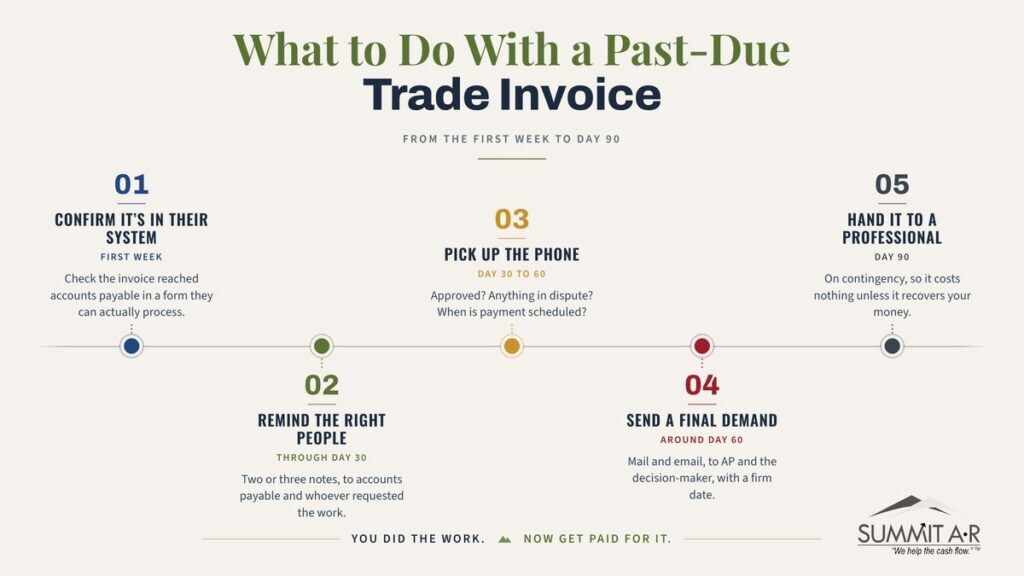
A clear sequence keeps you from waiting too long on a stuck account, or pushing too hard on a client who just needed the right paperwork. For most commercial service and maintenance accounts, it runs about 60 days before it’s time to send a past-due account to collections.
Confirm the Invoice Is in Their System in the First Week
Before you assume anything, make sure the invoice reached accounts payable in a form they can process. Ask whether it needs a signed work ticket, a W-9 or an upload to the client’s vendor portal, since any one of those can hold up payment.
Send Reminders to the Right People Through Day 30
Commercial payment reminders work best when they go to two people at once: the accounts payable contact and the person who requested the work. Each one should include the invoice number, purchase order number, site address, date of service and how to pay.
Two or three reminders in the first month is usually enough. A short, polite note that follows the basics of good collection letters tends to get more attention than a long one.
If your office is too busy to keep up with reminders, our pre-collection services can send them for you before an account ever goes to collections.
Pick Up the Phone Between Day 30 and Day 60
By the second month, a phone call tends to get further than another email. Call accounts payable first, then the property manager or facilities contact, and ask:
- Has the invoice been approved?
- Is anything in dispute?
- When is payment scheduled?
Calls like these work best when they’re friendly and specific, and the same tips for calling your debtor that work in other industries apply to trade accounts too.
If the client has a service agreement with you, check what it says about pausing non-emergency work on a past-due account. And whatever payment date they give you, confirm it in writing the same day.
Send a Final Demand Around Day 60
If the calls don’t produce a firm payment date, send a final demand letter by mail and email to both the accounts payable contact and the decision-maker. Include the balance, the invoices and sites it covers, a deadline of about 10 business days, and what happens if the deadline passes.
Keep the tone calm and factual. Once the balance is settled, you’ll likely want this client’s work again.
What a Client’s Response Tells You
What a business client says, or doesn’t say, usually points to which of those situations you’re dealing with, and many of the common unpaid debt excuses contractors hear have a simple fix. Here’s how to read the responses that come up most often, and what to do next.
| What you hear | What it usually means | Your next step |
| “It’s in the approval queue.” | Someone above your contact hasn’t signed off yet, and nobody is following up on it internally. | Ask who the approver is and when they’ll act, then follow up with both the approver and accounts payable on that date. |
| “We can’t pay without a purchase order number.” | The invoice is stuck in the client’s matching process, not in a dispute. | Get the number from the person who requested the work, reissue the invoice with it, and confirm it was received. |
| “The tenant is responsible for that repair.” | The landlord and tenant disagree about who pays, and you’re caught in the middle. | Go back to your signed work order, bill the party who authorized the work, and stay out of their lease dispute. |
| “The job went over the not-to-exceed amount.” | The client accepts the work but not the overage, and they’re holding the full invoice. | Split the invoice so the approved amount can be paid now, and send the overage with your documentation for approval. |
| No response for 60 days or more | The client may have decided your invoice can wait, or the business may have changed hands. | Send the final demand, then place the account with a collection agency while contacts and records are still easy to find. |
Legal Deadlines Every Trade Contractor Should Know
Deadlines are one of the easiest ways for contractors to lose money they had every right to collect. We’re not lawyers, and the rules vary by state, so use this section as a starting point and check the specifics where you work.
A mechanic’s lien is a legal claim against the property where you did the work, and on commercial jobs it can be one of the strongest ways to get paid. Lien rights come with strict notice and filing windows, and some states require a preliminary notice early in the job, especially for subcontractors.
Miss one of those windows and the lien right is usually gone, so check your state’s requirements at the start of any large job.

Every state also limits how long you have to sue over an unpaid debt, and that period depends on the state and the type of contract. As the Consumer Financial Protection Bureau explains, a debt doesn’t disappear when that period ends, but the right to take legal action to collect it can.
Business clients can also close, sell or file for bankruptcy, and a balance that sits for a year may end up owed by a company with nothing left to pay it. Acting within the first 90 days keeps more of your options open.
When to Hand the Account to a Professional
If a business client has ignored your reminders, your calls and a final demand, one more email probably won’t change much. At that point, a professional collection agency is often the faster way to get paid.
For most trade contractors, an agency is also simpler than other ways construction companies and contractors can collect on unpaid debts, such as filing a lien or going to court, because you don’t have to manage the process yourself.
Our collectors work commercial accounts for electricians, plumbers, HVAC contractors, property maintenance companies and restoration firms nationwide. Here’s what working with us looks like.
- You don’t pay unless we recover money. We work on contingency, so there’s no upfront fee and no cost for an account we can’t collect.
- We can find businesses that have moved or gone quiet. Our skip tracing department is overseen by a licensed private investigator who tracks down new addresses, owners and contacts when a client relocates or changes hands.
- We protect the relationships you’ve built. Our Preserve Human Dignity (P.H.D.) Philosophy means no threats and no aggressive tactics, which matters in a referral-based business where you may want that client’s work again.
- We can take legal action if it’s needed. Our full-service litigation team works with experienced counsel, and you approve every cost in writing first.
That respectful approach doesn’t come at the expense of results. Our recovery rates run nearly double the national average, and our client portal lets you upload accounts and track payments around the clock.

Habits That Keep Trade Invoices From Going Unpaid
The best collection call is the one you never have to make. A few habits at the start of every commercial account can prevent a lot of unpaid invoices.
- Run a credit application before you extend terms. A credit application with trade references, plus a personal guarantee from the owner on smaller businesses, tells you who you’re dealing with before you’re owed money.
- Get a purchase order or signed work order before dispatch. Written authorization before anyone heads to the site confirms who approved the job, what it covers, and which company is responsible for paying.
- Get written approval when a job runs over. A quick email from the property manager approving the extra cost prevents many not-to-exceed disputes.
- Put your terms and a collection costs clause in the service agreement. A due date, a late fee policy and a clause that shifts collection costs to the client only work if they’re signed before the work begins.
- Close every job with a signed ticket and photos. A signature from the site contact and pictures of the finished work can settle questions about the quality of the work before they turn into disputes.
It also helps to know the warning signs of commercial debt, like a client who pays a little later each month, so you can act before a balance gets out of hand.
Get Paid for the Work You Already Did
If a business client has ignored your reminders, your calls and your final demand, it’s time to let a professional take it from here. We work trade contractor accounts nationwide on contingency, with no fee unless we recover your money.
Did you find this article helpful? Just imagine how helpful our experts could be for your bottom line! Learn more about our full suite of services, or contact us today to discuss how we can help recover your lost revenue.
Frequently Asked Questions About Collecting Unpaid Trade Invoices
How Long Should a Contractor Wait Before Sending an Unpaid Invoice to Collections?
Most HVAC, plumbing and electrical contractors should place a commercial account with a collection agency at 60 to 90 days past due, once the client has ignored written reminders, at least one phone call and a final demand with a deadline. Waiting longer rarely helps, because businesses close, sell or change management. If the client has stopped answering entirely or the building has changed hands, it’s worth placing the account sooner, while contacts and records are still easy to find.
Who Is Responsible for the Invoice, the Property Manager or the Owner?
It depends on who signed your work order or service agreement and on what that document says. A property management company often signs as an agent for the owner, which can make the owner responsible for the bill. Other times, the management company contracts in its own name. Check the signature block and the billing name on the agreement before the work starts, and send invoices to the party named there so a change in management doesn’t leave your balance without an owner.
Does the Fair Debt Collection Practices Act Apply to Commercial Trade Invoices?
Generally, no. The Act covers debts people owe for personal, family or household purposes, so an invoice for commercial work usually falls outside it. That doesn’t mean anything goes, though. Some states require commercial collection agencies to be licensed or bonded or have collection laws of their own, and federal rules against deceptive practices and on autodialed calls and texts still apply. A reputable agency follows all of them, wherever your client is located.
Can I Stop Service on a Maintenance Agreement If the Client Doesn’t Pay?
Often you can, but it depends on what your service agreement says about past-due balances. Many agreements let the contractor suspend scheduled maintenance until the account is current, while emergency calls may be handled differently. Read the agreement before you act, tell the client in writing what you’re pausing and why, and give them a date to bring the account current. A clear written notice usually gets more attention than another reminder about the invoice itself.
Is It Worth Using a Collection Agency for Small Service Invoices?
It can be, especially when the agency works on contingency and charges nothing unless it recovers money. Small commercial invoices add up quickly across dozens of sites, and chasing a pile of $600 service calls takes hours your office staff could spend scheduling paid work. Summit A•R has no minimum balance, so you can place small and large accounts together. For very small balances, a few well-timed reminders before placement will often get the invoice paid without outside help.